Best Original Idea
Reale Film Festival — Awards
2025
 ICONEMIA
Film
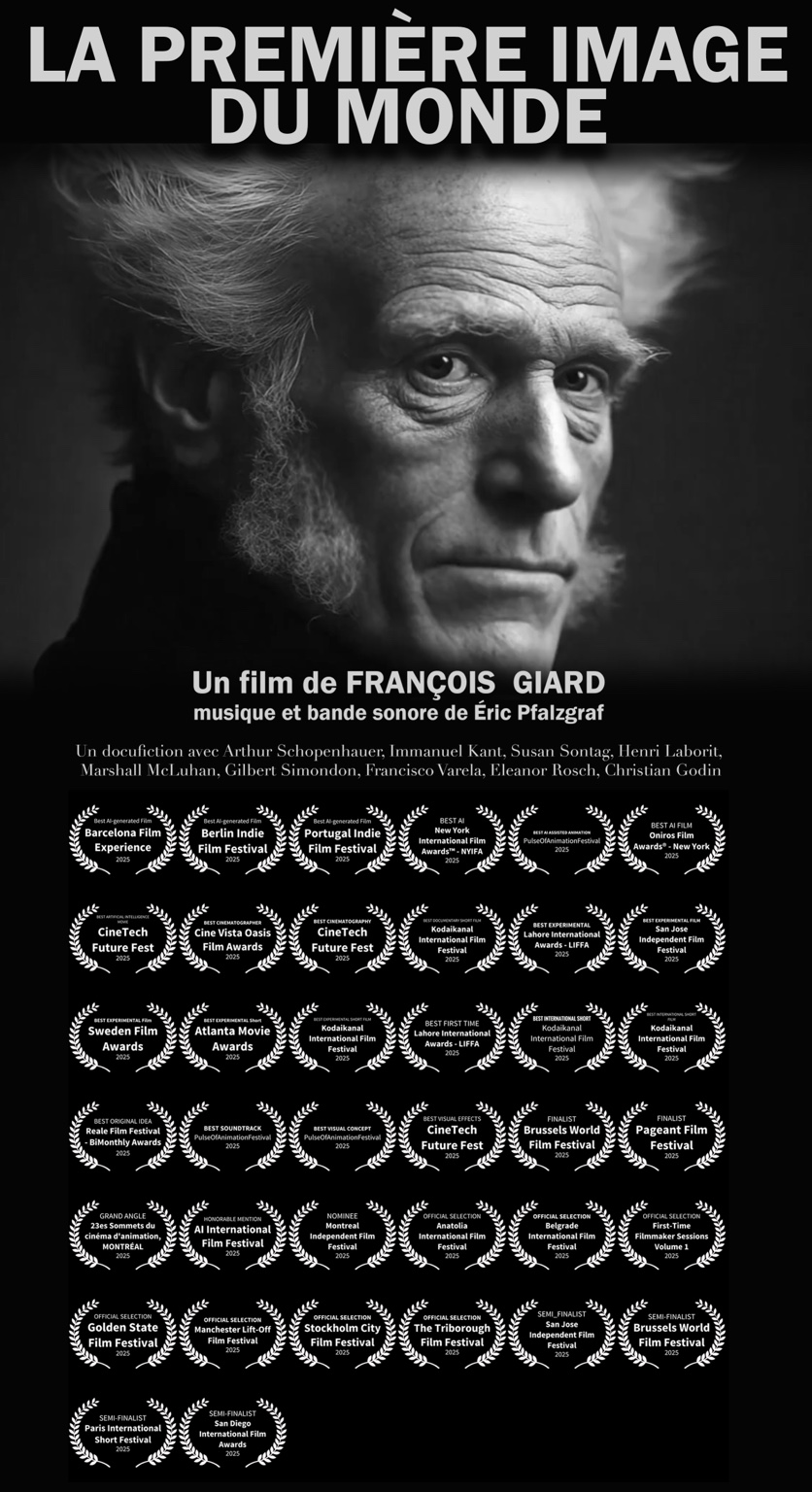
Un essai cinématographique sur l’origine, la puissance et la transformation des images.
La Première image du monde explore l’une des plus anciennes questions de l’humanité : quelle fut la première image? En croisant philosophie, sciences cognitives, animation, théorie des médias, archéologie et intelligence artificielle, le film retrace la longue évolution des images — des premières marques humaines jusqu’à l’IA générative. Une docufiction où l’on entend Schopenhauer, Kant, Simondon, Sontag, Godin, Varela et McLuhan discuter du concept de l’auteur sur la première image.
Le film soutient que les images ne sont pas simplement des représentations du monde; elles participent activement à la construction de l’expérience humaine.
Musique et conception sonore : Éric Pfalzgraf. Langues : anglais, français, allemand et espagnol, offerts avec sous-titres français ou anglais. Fiche technique : Dolby 5.1, Atmos, 4K.
La première image du monde, réalisé entièrement avec des outils d’IA, prolonge un parcours de recherche-création sur notre rapport fondamental aux images. J’appelle iconémie la condition qu’il explore : la vulnérabilité pathologique de la conscience imageante dans un monde saturé d’images techniques. Je voulais diagnostiquer cette condition, pas seulement l’illustrer — montrer comment la révolution technologique actuelle ne fait que révéler, avec une acuité nouvelle, une vulnérabilité qui était déjà la nôtre.
Réaliser ce film avec l’IA générative était un choix délibéré. Je voulais dénoncer l’iconémie en utilisant le médium même qui la propage, combattre le feu par le feu : les images générées par IA sont la manifestation la plus pure de l’iconémie — purement techniques, sans référent réel — ce qui en fait l’outil idéal pour l’exposer.
Le film repose sur une seule hypothèse : la première image du monde est nécessairement l’image de soi, et cette image de soi est le socle de toute empathie, puisque l’empathie exige une image stable de soi pour imaginer l’expérience d’autrui. Sa déstabilisation par la saturation des images est, pour moi, l’enjeu existentiel central de notre époque.
J’ai choisi une esthétique onirique — noir et blanc granuleux, mouvements flottants — pour inverser la manière dont les images techniques colonisent habituellement notre imaginaire ; ici, l’IA sert plutôt à rendre un monde intérieur. J’ai fait appel à des philosophes historiques — Schopenhauer, Kant, Simondon — comme avatars numériques, non pour tromper le spectateur sur leur présence, mais pour exposer à quel point toute représentation est construite.
Je n’offre pas de réponse définitive. Je demande au spectateur de s’interroger sur sa propre position : quelle image voulons-nous être ? Dans un monde où les images synthétiques prolifèrent, reconquérir une souveraineté sur notre propre représentation me semble une condition nécessaire pour rester humain.
Prix et distinctions — depuis janvier 2025
Best Original Idea
Reale Film Festival — Awards
2025
Best AI Film
Oniros Film Awards® — New York
2025
Best Soundtrack
PulseOfAnimationFestival
2025
Best AI
New York International Film Awards™ — NYIFA
2025
Grand Angle
23es Sommets du cinéma d'animation, Montréal
2025
Honorable Mention
AI International Film Festival
2025
Official Selection
First-Time Filmmaker Sessions, Volume 1
2025
Best Visual Effect
CineTech Future Fest
2025
Best Cinematography
CineTech Future Fest
2025
Best AI
CineTech Future Fest
2025
Official Selection
The Triborough Film Festival
2025
Official Selection
Golden State Film Festival
2025
Best Visual Concept
PulseOfAnimationFestival
2025
Best AI
New York International Film Awards™ — NYIFA
2025
Best AI Assisted Animation
PulseOfAnimationFestival
2025
Best AI-Generated Film
Barcelona Film Experience
2025
Best AI-Generated Film
Berlin Indie Film Festival
2025
Best AI-Generated Film
Portugal Indie Film Festival
2025
Semi-Finalist
Paris International Short Festival
2025
Semi-Finalist
San Diego International Film Awards
2025
Finalist
Pageant Film Festival
2025
Finalist
Brussels World Film Festival
2025
Best International Short
Kodaikanal International Film Festival
2025
Best Documentary Short Film
Kodaikanal International Film Festival
2025
Selected
Manchester Lift-Off Film Festival
2025
Nominee
Montreal Independent Film Festival
2025
Best First Time
Lahore International Awards — LIFFA
2025
Best Experimental
Lahore International Awards — LIFFA
2025
Best Experimental Short Film
Kodaikanal International Film Festival
2025
Official Selection
Anatolia International Film Festival
2025
Long métrage en développement
Un long métrage développé à partir des mêmes recherches sur les images, la mémoire, la présence et l’intelligence artificielle.
Long métrage actuellement en développement.
Au sommet de sa célébrité en ligne, un jeune influenceur comprend que son immense popularité est moins le fruit de relations réelles que d’algorithmes et d’intelligences artificielles qui façonnent et marchandent l’attention. En quête d’un monde encore authentique, il largue les amarres avec un ami de sa mère pour une traversée en voilier, espérant découvrir ce qu’il reste de réel au-delà de la bulle algorithmique.
Long métrage en développement
Un second long métrage actuellement en développement, prolongeant les mêmes recherches sur les images, la mémoire et le soi.
Ce film s’inspire de l’idée de Freud selon laquelle l’humanité a traversé plusieurs grandes blessures narcissiques : Copernic a montré que la Terre n’était pas le centre de l’univers, Darwin que l’être humain n’était qu’une espèce parmi d’autres, et Freud que notre esprit n’était pas entièrement maître de lui-même. Il pose alors une question contemporaine : l’intelligence artificielle annonce-t-elle une quatrième grande blessure narcissique, remettant en cause notre place, notre singularité et notre identité?